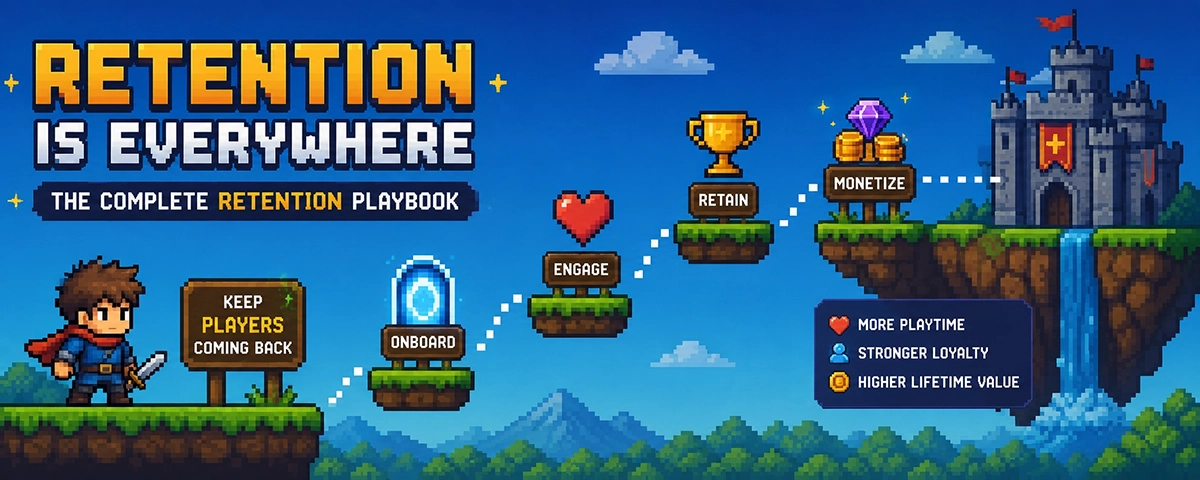
Let's start with something uncomfortable: the average mobile game loses 62% of players on the very first day. Not Day 7. Day 1. By the end of the first week, over 85% are gone. By Day 30, you're left with somewhere between 3% and 10% of your original cohort, depending on your genre.
If you're in the industry, those numbers aren't shocking to you. They've been normalized. Industry benchmarks exist, and when your D7 looks like everyone else's D7, it's easy to shrug and say "that's just how it is." The problem is, that shrug is costing you an extraordinary amount of money — because it is not, in fact, just how it is. Not for everyone.
The top 10% of mobile games by retention don't operate in the same universe as the industry average. Their players stay at twice or three times the rate. That gap compounds with every acquisition campaign you run. A 5-point improvement in Day-7 retention doesn't feel dramatic — but run the math on 100,000 installs and it becomes the difference between a struggling studio and a profitable one.
This post is about that gap. Where it comes from, how big it actually is across different genres, and the 12 systems that separate studios that obsess over retention from the ones that quietly wonder why their LTV math never works out the way their UA spreadsheet predicted.
Before we get into strategy, let's ground this in actual numbers. Assume you run a campaign and acquire 10,000 new players today. Here's what happens to that cohort under three scenarios — industry average, top 25%, and top 10%.
If each D30 active player is worth $2/month in ad revenue or IAP — a conservative estimate across most genres — the revenue difference from a single cohort is: $1,000 (average) vs $5,000 (top 10%). Same acquisition cost. Same creative. Same media channels. Five times the monthly recurring value, purely from what happens after the install.
Scale that across a few hundred thousand monthly installs and the gap becomes existential. It's the difference between a game that breaks even and one that funds sequels. Every single improvement to your retention curve is a multiplier on every dollar you spend on UA. This is why retention isn't a UX problem or a design problem — it's your most important business problem.
"Every dollar you spend on UA is multiplied by your Day-30 retention rate. Fix retention first — then spend on acquisition."— The insight that separates growth teams from acquisition teams
These are compiled from industry reports across major analytics platforms. Use them as a diagnostic, not a target — because the goal isn't to match the top 10%, it's to understand what they're doing that you're not.
Hyper-Casual
Puzzle runners, tap games, idle clickers
Casual Games
Match-3, word games, time management
Mid-Core Games
Strategy, RPG-lite, tower defense, city builders
Strategy & RPG
Deep RPGs, 4X strategy, gacha, collectible games
The top performer's curve doesn't start dramatically higher on Day 1. The real divergence happens across the first 30 days — tiny differences in daily return rates compound into massive gaps in LTV.
When you look at what top performers actually do differently, it's not one secret mechanic. It's a set of systems that reinforce each other. Miss one and you're below average. Get three or four right and you start pulling ahead. Get all six working and you're in the top 10%.
Top performers obsess over the first 3 minutes. They test first-session completion rate and correlate it to D2 retention. Average studios launch without measuring it at all.
Top games have three loops running simultaneously: the core loop (minutes), a progression loop (days), and a meta loop (weeks). Most games have one or two and then run out of reasons to keep playing.
Top performers treat their game as a service — regular live events, seasonal content, surprise gifts. Average studios ship and pray. After 90 days, a static game feels dead.
Games with meaningful social features retain 30-40% better than their genre average. Not because players are social creatures, but because social creates external accountability.
Top studios plot their retention curves weekly. They know exactly which day has the biggest single-day drop, what game event correlates with it, and what they're testing to fix it.
Best-in-class studios have a full re-engagement stack: offline rewards, timed push notifications, comeback campaigns. Average studios send one "we miss you" email and nothing else.
"The D30 cliff isn't about the game getting worse. It's about players running out of reasons to come back."— The meta-loop problem that most games never solve
Strategies 1–4: Getting the first week right. If you don't nail these, nothing else matters.
This sounds like hyperbole. It isn't. Research across multiple analytics platforms consistently shows that players who complete a meaningful first session — one where they experience the core fun loop and understand why this game is worth their time — are three to four times more likely to return on Day 2 than players who bounced early. Day 2 retention is the single strongest predictor of long-term retention. And Day 2 retention is almost entirely set in the first session.
The concept you're looking for is the "aha moment" — the specific instant when a player understands, viscerally, why this game is fun. Not why it's interesting. Not why it might get better later. Why it's fun right now, in this moment. Clash Royale found theirs: new players are in a real battle within 90 seconds of installing. They've won a match, deployed cards, watched their opponent's tower crumble — all before they've read a single line of tutorial text. That is the aha moment, and it happens before the game has asked for anything in return.
Most studios don't know where their aha moment is. If you're one of them, here's how to find it: look at the cohort of players who retained to Day 7. What did they do in their first session that players who churned on Day 1 didn't do? Was there a specific level they reached? A mechanic they unlocked? A social interaction they had? That behavior — whatever it is — is your aha moment. Your job is to get every new player to that moment as fast as humanly possible.
Players who experience the core fun loop in their first session retain to D2 at 4× the rate of players who didn't reach it. The first session isn't onboarding — it's your core product pitch.
The practical implication is uncomfortable for most teams: everything in your first session that isn't delivering fun should be removed or postponed. The backstory, the extensive tutorial, the shop walkthrough, the friend-invite popup — these things do not help retention and may actively harm it. A player who bounces in the tutorial has never experienced your game. They've only experienced your onboarding.
Measure first-session completion rate right now. If it's below 60%, you have a critical problem upstream of every retention strategy in this post. Time your first session. Count every second from install to the first moment of actual gameplay. If it's more than 90 seconds, you have work to do. The fastest path to better D2 retention is almost always a shorter, leaner, faster path to the fun.
Here's a counterintuitive thing about game motivation: players don't keep playing because they're winning. They keep playing because they're improving. The brain releases dopamine not at the moment of victory, but at the moment of recognized progress. That distinction matters enormously for retention design.
Psychologist Mihaly Csikszentmihalyi described this as "flow" — the state of engagement that happens when a challenge is perfectly matched to the player's current skill level. Too easy: boredom, and the player leaves. Too hard: frustration, and the player leaves. The narrow channel in between, where the game feels just slightly beyond what you can currently do but absolutely achievable with a bit more effort — that's where retention lives.
The progression wall is the most common D7-D14 retention killer, and it's almost always a flow problem. The game starts easy, teaches the core mechanics, and then suddenly introduces a challenge spike that the player hasn't been prepared for. The spike isn't random — it usually correlates precisely with the point where the tutorial scaffolding ends and the "real" game begins. Players who hit the wall stop playing. They don't rage-quit. They just quietly decide not to come back.
Fixing this requires two things. First, a skill curve that's actually calibrated — gradually increasing challenge that matches the growing skill of an engaged player. Second, and more subtly, visible progress metrics that show the player they're improving even when they don't win. XP bars, level-up screens, achievement unlocks, stat increases — these aren't gamification fluff. They're the feedback system that keeps players in the flow channel by showing them the gap between where they are and where they're going. Players who can see their progress stay. Players who can't, don't.
Games with visible skill progression metrics see roughly 40% better D7 retention than genre-matched games without visible progression. Players need to see that they're getting better — not just that they're getting more rewards.
Map your difficulty curve against your retention curve. Find your biggest single-day retention drop between D3 and D14. Now look at what players encounter in the game at exactly that point. Is there a difficulty spike? A mechanic introduction that isn't scaffolded? A content gap? Nine times out of ten, that's your progression wall — and fixing it is the single highest-ROI improvement you can make to mid-funnel retention.
Duolingo has shared data showing that users with 7-day streaks have a 4× higher 30-day retention rate than users without streaks. That number shouldn't surprise you — but the mechanism behind it should. It's not that the daily streak itself is fun. It's that the streak changes the player's relationship to the game from "something I play" to "something I do." That's a fundamentally different category of engagement, and it's extraordinarily powerful for retention.
The psychology behind this is loss aversion, which is one of the most robust findings in behavioral economics. People work substantially harder to avoid losing something they already have than to gain something equivalent they don't have. A player who has a 47-day streak is not thinking about the rewards ahead. They're thinking about the 47 days they will lose if they miss today. That fear of breaking the chain is more motivating than almost any positive incentive you can offer.
But here's the nuance: the mechanic has to feel like an invitation, not an obligation. A daily task list that feels like homework will create resentment and lead to burnout and eventual churn — players quit out of fatigue rather than disinterest. The distinction in execution is subtle but important. The daily reward should be worth the visit on its own merits: meaningful, relevant to the player's current progression, and genuinely valuable. If the "daily reward" is something players routinely ignore, the streak mechanic around it is worthless.
Two design details that are consistently underused: First, the streak forgiveness mechanic. Letting players skip one day without breaking their streak — a "streak freeze" — increases long-term retention because it removes the hard-quit moment that happens when a player misses a day and sees their streak reset to zero. Counterintuitively, the option to fail without consequence makes players less likely to fail. Second, the calendar reveal: showing players the full month's rewards upfront activates planning behavior. Players who can see what's coming on Day 21 make decisions today based on that future goal. That's appointment retention — the holy grail.
Players with 7-day streaks retain at 4× the rate of players without streaks. The streak isn't a feature — it's a relationship change. Players with streaks don't "play your game" anymore. They "do their daily."
Your daily system needs: (1) A reward that's genuinely worth visiting for. (2) A streak counter that's prominent and satisfying to maintain. (3) A streak freeze option — at minimum, let players earn one freeze per week. (4) A calendar showing the next 7–30 days of rewards. (5) A soft FOMO element — the reward shown for tomorrow should be slightly more exciting than today's, creating pull for the next session.
Here's the stat that should make every game team uncomfortable: roughly 72% of game push notification permissions are disabled or ignored within the first week. That's not because players don't want to be reached — it's because most games earn that outcome by spamming generic messages that don't deliver value. The average player gets contacted too often, at inconvenient times, with messages that don't tell them anything worth knowing. So they turn it off, and the studio wonders why their re-engagement campaign isn't performing.
The first principle of effective push notifications is permission timing. Asking for notification access on Day 1, before the player has experienced anything worth being notified about, gets about a 40–45% acceptance rate. Asking after the player's first win — when they're in a positive emotional state and have a concrete reason to want updates — gets 60–70%. This is a 25-point difference in your potential notification audience, and it requires one change: delay the permission request by 10 minutes.
The second principle is value-first messaging. The notification must communicate something the player actually wants to know — and ideally something that can only be experienced by opening the app, not described in the notification itself. Compare: "Open Clash Royale" vs. "Your chest is ready — it expires in 2 hours." The first tells the player nothing. The second creates urgency, communicates value, and implies loss if they don't act. The difference in CTR between these two message types is not marginal — it's often 3 to 5 times higher for the value-forward version.
Timing personalization is the final lever and the most underused. Most studios send notifications at a fixed time — either a global 9 AM push or time-zone adjusted but still fixed. The better approach: analyze each player's historical session start times and send the notification 15 minutes before their typical play window. A player who consistently opens the game at 8:15 PM should receive their notification at 7:55 PM. This level of personalization requires ML infrastructure that small studios don't always have — but even a rough segmentation (morning players, lunch players, evening players) outperforms a one-size-fits-all approach dramatically.
Of game push notification permissions are disabled within the first week. The channel isn't broken. The messages are. Treat the notification like a conversation — something you only send when you have something worth saying.
If you're sending more than one push per day, you're almost certainly hurting retention more than helping it. Decide on a single priority each day — the most important reason to open — and send that. The message should communicate urgency or value (ideally both) and should be phrased as specifically as possible. "Your 24-hour event ends tonight" beats "Play now!" by a factor of three in most A/B tests.
Strategies 5–8: The architecture of long-term engagement. This is where good games become great businesses.
Nearly every mobile game that crashes at Day 30 has the same underlying problem: it only has one engagement loop. Players run through it, reach the end (or the paywall, or the content gap), and conclude there's nothing left to do. This is the single most common cause of mid-retention churn, and it's almost entirely preventable with intentional progression architecture.
The framework that separates sustained-engagement games from flash-in-the-pan ones is the triple-loop system. Each loop operates on a different timescale and serves a different retention function:
The Core Loop (10–90 seconds): the elemental action that defines the game. Match tiles. Build a unit. Attack an enemy. Deploy a card. This loop must be intrinsically fun — enjoyable to repeat indefinitely regardless of rewards. If players are only doing the core action to earn the rewards, not because the action itself is satisfying, your core loop is broken and no amount of meta-game progression will fix it.
The Progression Loop (5–30 minutes per session, 1–30 days to complete): the reason for doing the core action. Level up, unlock new units, upgrade your base, earn currency, build your collection. This loop provides the why behind the what. It's where most games invest their design energy, and it's necessary — but it's not sufficient. Players who "complete" the progression loop (reach max level, fully upgrade everything, exhaust the content) will churn unless there's a meta loop to pull them further.
The Meta Loop (weeks to months): the overarching reason to keep playing beyond the first progression loop completion. Competitive ranking systems. Guild dynamics and alliance wars. Seasonal narratives. Cosmetic collection. World-building and lore that rewards time investment. The meta loop is what separates a game people play for a month from one they play for three years.
Games with active meta-loops — visible long-term goals that go beyond gear and level — retain players at D30 at roughly 3× the rate of games without one. The meta loop is not a "nice to have" feature; it's the architecture that prevents the Day-30 cliff from forming at all.
Write down your core loop, your progression loop, and your meta loop on a whiteboard right now. If you can't immediately name the meta loop — what a player who has "finished" the progression content is chasing — that's your D30 retention problem made visible. The fix isn't adding content. It's adding a reason to exist past the content.
The data on this is remarkably consistent across genres and platforms: players with at least one social connection in a game — a friend, a guild member, an ally — retain at 30–40% higher rates than solo players in the same game. This isn't because social features are inherently entertaining. It's because social creates a retention mechanism that no in-game system can replicate: external accountability.
When you have a friend in a game, your absence has consequences. Your guild needs you for the war tonight. Your friend is two levels ahead and you need to catch up. Your ally left you a message in the chat. These external forces create pull back to the game that is qualitatively different from — and more powerful than — internal game mechanics like daily rewards or streak counters. The daily reward gives you a reason to open the app. Your guild gives you a reason to care.
The most effective social retention mechanics are the ones that create asynchronous social interaction — player-generated content that exists when the other player isn't online. In racing games, the ghosts of your friends' best times are always available to race against. In Clash of Clans, your base defends itself against other players' attacks while you're asleep, and you wake up to a replay of what happened. In word games, your friend's challenged board is waiting when you open the app. These mechanics create the feeling of social engagement without requiring synchronous play — and that matters enormously in a world where schedules don't align.
The onboarding implication is critical and chronically under-designed: getting a player's first social connection within their first three days dramatically improves D30 retention. A player who joins a guild on Day 2 has a reason to come back that they didn't have on Day 1. The social onboarding moment — finding friends, joining a clan, connecting accounts — should be treated with the same priority as the first-session experience. It's equally important for retention, and most games bury it.
Average D30 retention lift for players with at least one active social connection vs. solo players in the same game. Social features are not a UX enhancement — they're a retention architecture. Build them like it.
The best time to prompt a new player to join a guild or find friends is between their first win and their end of first session — not at install, and not buried in a settings menu. Create a natural narrative moment: "You've just won your first battle. Other players want you on their team." The guild invitation should feel like an achievement, not a feature tour.
Almost every game treats player absence as a neutral event. The player was gone; now they're back; here's where they left off. This is a missed retention opportunity of the first order. The period between a player going dormant and potentially churning for good is one of the highest-value windows in your entire retention strategy — and most studios do almost nothing with it.
The most effective mechanic in this window is the offline reward: a meaningful, relevant gift that accumulates during the player's absence and is waiting when they return. Clash of Clans does this perfectly — your gold and elixir collectors have been running while you were away, and there's a pile of resources ready to harvest. Farming games build their entire loop around this mechanic. The key psychological principle is that returning should feel like arriving at a place that's been active in your absence, not returning to exactly the state you left.
The sophistication level matters here. A generic "welcome back, here are 50 coins" is better than nothing but significantly less effective than a personalized return experience. "You've been away for 3 days. Your fields are ready to harvest, your troops have been training, and one of your guild members sent you a message." Each element of that return experience tells the player that the world continued without them — which makes it feel alive and worth re-entering. Personalization isn't just nice; it's the delta between a player deciding to re-engage versus deciding they've already moved on.
The re-engagement window deserves special attention. Data consistently shows that the optimal window for win-back is between 7 and 21 days after a player's last session. Before 7 days, they may just be taking a natural break — contacting them aggressively in this window can actually increase churn. After 30 days of silence, most players have psychologically "completed" the game — the re-engagement cost is very high and the conversion rate drops dramatically. The sweet spot is that 7-21 day window, where the player remembers the game positively but hasn't yet made a final decision to leave.
Re-engaging a lapsed player within the 7–21 day window costs 3–5× less than acquiring an equivalent new player. Your most cost-efficient UA channel isn't Google or Meta — it's your own lapsed player base, reached with the right message at the right time.
Design a three-message re-engagement sequence triggered by 7 days of inactivity. Touch 1 (Day 7): new content or community update — "Here's what's changed since you left." Touch 2 (Day 14): social pull — "Your guild misses you / your friend is two levels ahead." Touch 3 (Day 21): time-limited incentive — "Come back this week and claim a special welcome-back gift." Each message should be progressively more personal and more generous. The sequence should feel like a friend reaching out, not a marketing campaign.
A static game — one that doesn't change after its initial release — has a predictable retention arc. Players engage, explore the content, reach the end, and leave. The curve might look reasonable in the first month, but the 60-day and 90-day numbers tell the real story. Without new reasons to return, a static game slowly empties out until it reaches its maintenance player base (typically 1–3% of peak DAU) and stays there until the servers shut down.
Live events are the structural solution to this problem. They create appointment play — a specific reason to open the game on a specific day — that external game mechanics can't generate. When players know that a limited-time event starts on Friday and ends Sunday, they plan their weekend around it. When a new seasonal update drops, lapsed players who haven't opened the app in two weeks suddenly have a reason to check back in. The game is alive again, and alive games retain players.
The Battle Pass deserves its own analysis, because it's one of the most powerful retention mechanics ever designed — and one of the most frequently misimplemented. Done right, the Battle Pass creates a layered set of motivations that work simultaneously: sunk cost (players who purchase the pass feel obligated to extract its value), clear short-term goals (this week's challenge), clear long-term goals (unlock the tier 50 cosmetic), and FOMO (it expires at the end of the season). Players who might not log in on a quiet Tuesday will open the game to advance their Battle Pass — and once they're in, they might stay for an hour. The session was created by the pass, even if the session itself was about the core game.
The risk with live events is event fatigue — the "crying wolf" effect that happens when you run events so frequently that players start ignoring them. The solution is quality over quantity: fewer, more meaningful events that feel like genuine occasions rather than regular content drops with a "event" label attached. One high-quality event per month with genuine limited-time cosmetics and story content will outperform four "event weekends" with minor reward variations every time.
Games with two or more high-quality live events per month have 2.3× higher D30 retention compared to games with no scheduled live operations. The game needs to feel like it's going somewhere — events are how you demonstrate that it is.
Strategies 9–12: The long-term systems that separate games with 3-month lifespans from ones that run for years.
The meta-game is everything that sits outside the core loop and gives players a reason to keep playing after the progression loop is "complete." It's the layer that determines whether a player stays for two months or two years. And it's the layer that most games either don't have, don't design intentionally, or bolt on as an afterthought when they notice their 90-day retention has collapsed.
Cosmetics as social currency are the most underappreciated meta-game driver in mobile. When a player's appearance in the game world communicates their history — how long they've been playing, what events they participated in, what achievements they've earned — their cosmetic collection becomes a form of identity. Players who feel their in-game identity is tied to the game don't leave casually. The outfit they're wearing, the trail their character leaves, the border on their player card — these things sound trivial outside the game and feel deeply meaningful inside it. Design them accordingly.
Collection mechanics tap into a psychological mechanism that's distinct from achievement mechanics: completion drive. The brain responds differently to "I got a reward" versus "I completed a set." The dopamine hit from completing a collection is significantly larger than individual acquisition, which is why games built around collection (Pokémon, card games, any game with a compendium) have structurally better meta-game retention than games that don't. If your game has 50 characters, 50 cosmetics, 50 achievements, or 50 anything — make sure the player can see which 50 they have and which they're still missing. The gap is the retention mechanism.
The most durable meta-game retention comes from what you might call investment and identity — situations where the player has put enough into the game that leaving feels like abandonment rather than a neutral decision. A player who has built a guild from 5 members to 50, organized two successful Clan Wars, and is known in their community as a skilled leader doesn't leave a game lightly. That investment creates a kind of psychological lock-in that no mechanical feature can match. Your goal as a designer isn't to trap players — it's to create enough genuine value and identity that choosing to leave actually costs something real to them.
Ask these questions about your game: (1) What does a player who has "completed" the progression loop do next? (2) How does a veteran player look and feel different from a new player, in ways the veteran is proud of? (3) What social role does your game allow players to occupy — leader, strategist, collector, competitor? (4) Are there long-term goals that take months to achieve and are visibly displayed to other players? If you can't answer any of these clearly, your meta-game needs work.
A mobile game's player base isn't homogeneous, but most games treat it like it is. Every player gets the same difficulty curve, the same onboarding, the same progression pace, the same notification cadence. This is a massive efficiency loss: the player who opens the app twice a day and grinds for 45 minutes per session has fundamentally different needs than the one who plays for 7 minutes on her lunch break. Treating them identically serves neither of them well.
The most impactful form of personalization for retention is adaptive difficulty. The evidence on this is unambiguous: games with difficulty adaptation — systems that detect when a player is struggling and temporarily reduce challenge, or when they're breezing through and increase it — retain measurably better at the D7 and D14 marks than games with fixed difficulty. The mechanism is the flow principle from Strategy 2: players who are perpetually challenged just beyond their current capability don't hit walls. They stay in the channel. Adaptive difficulty isn't rubber-banding or making the game easier for people who are bad at it — it's real-time calibration of the flow state for each individual player.
Content pacing personalization is equally important for long-term retention and almost never implemented. Some players burn through content at three times the pace of others. If your content pipeline can't keep up with your fastest players, those players will always churn before your average player does. The solution isn't to slow down the fast players — it's to have deeper content layers available for them (advanced challenges, ranked modes, elite seasonal content) so they never reach the bottom of the content barrel.
The VIP mechanic — making long-term players feel acknowledged and special — is another chronically underused retention tool. Not pay-to-win VIP, which creates toxicity, but tenure-based recognition: a different visual treatment for players who have been in the game for a year, priority customer support, a special chat channel for veterans, the ability to display a "Founder" badge. These cost almost nothing to implement and create a powerful sense of belonging and status that significantly increases switching costs. A player who is visibly recognized as a veteran has real social equity to lose by leaving.
Reduction in D7-D14 churn from "hitting the progression wall" in games that implement adaptive difficulty systems versus genre-matched games with fixed difficulty. The flow state is not a luxury — it's the engine of mid-funnel retention.
You don't need an ML system to start personalizing. Begin with three player segments based on session frequency: daily actives, 3x-week players, and weekly-or-less players. Each segment needs different notification timing, different challenge calibration, and different content pacing. That alone will show you where the biggest gaps are — and the data from those three segments will tell you where to invest in deeper personalization next.
Most studios find out they have a retention problem when they look at their DAU chart and notice it's declining. By that point, you've already lost the players. The studios at the top of the retention leaderboard find out about their retention problems seven days before those players leave — and they've already started testing fixes.
Churn prediction is the practice of identifying behavioral signals that precede player departure. The data on which signals are most predictive is remarkably consistent: declining session length is the earliest signal (typically 10–14 days before churn). Declining login frequency follows (7–10 days before). Reduced monetization engagement comes next if they're paying players. Finally, increased "menu bouncing" — sessions that consist mostly of opening menus, checking inventory, and exiting without completing core-loop actions — is typically present in the final 3–5 days before a player churns for good.
Armed with this signal data, the intervention opportunity is clear: when a player's session length drops two standard deviations below their personal baseline over a 5-day rolling window, they're a high churn risk. The right response is personalized re-engagement: a notification that references something specific to their play history, not a generic "come back" message. "Your base is almost ready for Town Hall 8 — you're only 3 upgrades away" will outperform "We miss you!" by a factor of four, because it tells the player that the game knows where they are and is giving them a specific, achievable reason to return.
Exit analysis — understanding why players left after they've already gone — is the complement to churn prediction. The most effective form isn't the post-churn survey (response rate: 2%) but behavioral analysis: correlate your biggest single-day retention drops to game events. If Day-8 retention drops 15 percentage points more than Day-7, something happens to players in the game on Day 8 that causes disproportionate dropout. That's almost always either a progression wall, a monetization prompt, or a content gap — and it can be found by looking at what players encounter at exactly that experience point.
The average lead time between early behavioral churn signals (declining session length) and actual player departure. You have a 7-day intervention window. Studios that build prediction models into their analytics stack can identify at-risk players in time to do something about it — most don't.
Pull your daily retention curve for the last 90 days. Find the day with the single largest percentage-point drop between consecutive days — your retention cliff. Now look at your event log for that day. What game milestone do players hit at that exact point? What prompt do they see? What content do they encounter? The correlation almost always reveals a specific, fixable design decision. The cliff isn't bad luck — it's a design bug waiting to be found.
Your UA team is spending a significant budget acquiring new players every month. They're optimizing CPIs, testing creatives, managing bids. But there's almost certainly a cheaper, higher-converting audience sitting untouched in your own database: players who were engaged enough to install and play your game, who had a positive enough experience to retain past Day 1, and who eventually went quiet for reasons that might not be permanent. Re-engaging a lapsed player from this cohort costs, on average, three to five times less than acquiring an equivalent new player — and they convert at higher rates because they already know the game.
The most effective re-engagement message is almost always about new content, not offers. The instinct is to send a discount or a "welcome back" gift — and while those have their place (Stage 3 of the sequence, as described above), the highest-performing re-engagement trigger is telling lapsed players that the world they loved has grown. "A new chapter just launched" or "The Winter Festival is back — your city is decorated and waiting" outperforms "Come back, here are 100 free gems" in nearly every A/B test. The new content message conveys that the game is alive and worth returning to. The discount message conveys that you're desperate, which makes the game sound like it's dying.
Cross-channel coordination is the advanced play here. Email plus push together have 40% higher conversion than either channel alone — but the messages need to be sequenced thoughtfully, not blasted simultaneously. Push first (highest immediacy, most personal), email three days later if push didn't convert (different context, longer message acceptable), and follow-up email seven days after that if still no conversion (final touch, often with the "here's what's new" narrative combined with a return incentive). The sequence respects the player's attention and gives each channel a different job to do.
Finally, the targeting of re-engagement campaigns matters as much as the creative. Not all lapsed players are equal. Players who churned between Day 7 and Day 21 are far more likely to re-engage than players who churned on Day 1 or Day 2 — the former had a meaningful relationship with the game, the latter barely knew it. Segment your re-engagement audience by original engagement depth, not just recency, and allocate budget toward the cohorts that show the highest historical re-engagement rates. The data is already in your analytics stack. Running the segmentation is one query and one campaign adjustment away.
Higher conversion rate for cross-channel (email + push) re-engagement versus single-channel reach. The channels don't just add — they multiply. Each touchpoint reinforces the previous one and gives the player a different context to engage with your message.
Start with the cheapest, highest-ROI piece: improve your push notification for lapsed players (Day 7–21 inactivity trigger). Add email if you're collecting addresses. Then add retargeting on paid channels for the Day 21–60 cohort. This sequence lets you validate each channel before investing in the next. Most studios skip straight to paid retargeting because it feels like "real" marketing — but their push and email programs are often so underoptimized that fixing those first would deliver better returns at a fraction of the cost.
Everything in this post is more useful if you know exactly which part of your retention curve is broken and why. Here's the process for finding out — run it before you implement anything.
Pull D1 through D30 retention for your last 90-day install cohort. Don't average it — keep it daily. You're looking for the shape: Is it a steep cliff early (D1–D3 problem) or a gradual slope (progression/content problem) or a sudden drop at a specific day (wall problem)? Each shape has a different diagnosis and a different fix.
Use the benchmarks in this post as your reference. Are you above or below average on D1? D7? D30? The answer tells you whether you have a first-session problem, a mid-funnel problem, or a meta-game problem. The gap size tells you how urgently you need to fix it.
Identify the single day with the largest percentage-point drop between consecutive days. That's your cliff. It's the point where the most players are deciding not to come back. Everything else you fix while this exists is building on top of a leak.
What do players experience in the game at exactly the point where your cliff occurs? Look at level, session count, time played, and game-event triggers. Nine times out of ten, the cliff correlates to a specific design decision: a tutorial ending, a difficulty spike, a first paywall prompt, a content gap, or a missing hook for the next session.
Don't try to fix everything at once. Form one specific hypothesis: "Players drop off at Day 8 because they hit the level-23 progression wall without enough context about what to do next." Design one fix for that hypothesis, test it against a control group, and measure the D7 and D14 retention difference. Build your roadmap from evidence, not intuition.
Not every retention fix requires a multi-month rebuild. Some of the highest-impact improvements are remarkably fast to ship. Here's how to think about the stack.