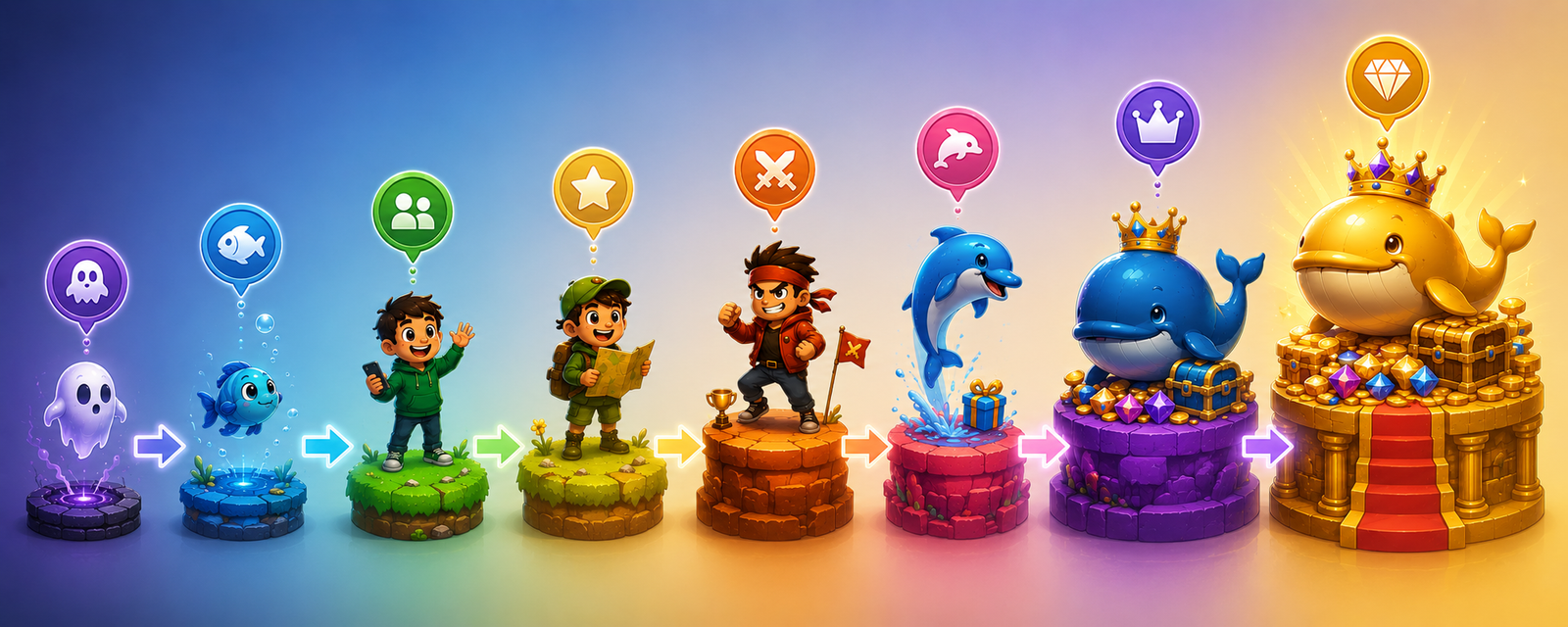
← Surface · · · · · · · · · · · · · · · · · · · · · · Deep →
Here's a number that almost every mobile game developer knows intellectually but rarely fully internalizes: roughly 1% of players generate between 50% and 80% of a typical free-to-play game's total revenue. Not 10%. Not 20%. One percent. Meanwhile, about 60–70% of your player base will never spend a single dollar — and they're not useless. They're the ecosystem that spending players need to feel excited about playing.
This is the paradox that makes mobile game design genuinely complex. You're simultaneously designing for people who will never pay (but must be happy enough to keep playing, because a dead social ecosystem kills the game for everyone) and for a tiny elite who might spend hundreds of dollars per month if the right features exist for them. Design only for the spenders and you'll hollow out your player base. Design only for the free players and you'll run out of money before you run out of content.
The studios that get this right — Supercell, Niantic, HoYoverse, Dream Games — don't choose between these groups. They build systems that serve every tier simultaneously and create a natural progression that moves players toward deeper engagement and, eventually, spending. This blog covers every meaningful player segment in mobile gaming, what each type wants, and — critically — how you move them from wherever they are toward the tier above.
Before you can convert players or build features that serve them, you need to understand who they are. Not just their spending level — their motivation, their psychology, what they're actually looking for when they open your game.
Ghost Players
Downloaded · Never really engaged
Ghost players downloaded your game, opened it once or twice, and disappeared. They're not angry — they just weren't hooked. This is the largest segment of your install base and the hardest to do anything about, because they're gone before you can understand why.
Free Players (Minnows)
Active · Engaged · Never spend · Essential
Free players are your most misunderstood segment. Studios either ignore them entirely (mistake) or try to force them into spending immediately (bigger mistake). Minnows are the ocean your dolphins and whales swim in. They fill leaderboards, populate guilds, provide opponents in PvP, and create the social mass that makes competitive features meaningful.
Achievers
Completionists. Every badge. Every collection. Every percentage point.
Achievers are your most underestimated segment. They'll grind for six hours to earn a badge that a non-achiever would never notice. They complete every quest, track every collection, and feel physical discomfort when a completion percentage isn't at 100%. Their spending is triggered by a very specific emotional moment: the gap between "almost complete" and "complete" is intolerable when the missing item is gated behind a paywall.
Competitors
Win. Rank. Dominate. Everything else is killing time between matches.
Competitors are your highest-converting segment from free to paying. They're also the most sensitive to pay-to-win design. When a competitor spends, they're buying a better chance of winning. They'll tolerate reasonable spending for time saves or progression boosts — and churn violently if they believe the game is unwinnable for free players, because then ranking means nothing, and ranking is everything to them.
Dolphins
Regular spenders. The backbone of sustainable F2P revenue.
Dolphins are the healthiest segment for a sustainable mobile gaming business. They've built a spending habit — the monthly battle pass, the occasional bundle, the season pass. Their spending feels normal to them. The battle pass is the single most powerful feature ever invented for creating and retaining dolphins.
Whales
$100–1,000+/month. 1% of players. 40–60% of your revenue.
Whales are complex. Their spending isn't primarily about financial capacity — it's about identity, competition, collection, and status. A whale who spends $500/month on Genshin Impact isn't doing it because $500 is trivial to them. They're doing it because getting that five-star character matters deeply — for collection completion, competitive advantage, and the satisfaction of the pull.
Super Whales
$1,000–$10,000+/month. The rarest player. The deepest ocean.
Super whales are a segment that most casual games will never see, but which certain genres absolutely depend on. Strategy games and heavy PvP titles sometimes have a handful of super whales who collectively fund the entire development budget. These players have moved beyond buying content — they're buying server dominance, social prestige, and a form of celebrity status within their game community. The cardinal rule: there must never be a spending ceiling for a super whale.
The spending tiers describe what players spend. But they don't describe what motivates them. A $20/month player could be motivated by social belonging, competitive ranking, collection completion, or the pure joy of discovery. These different motivations require different features — and different conversion approaches. These four archetypes, first described by Richard Bartle in 1996, are still the most useful behavioral framework in game design.
Driven by discovery. They want to see everything the game has to offer — every mechanic, every area, every piece of lore. They're the ones who find bugs and read patch notes. They convert when the game keeps surprising them. They churn when the content runs out.
Features: New content regularly, complex mechanics to discover, hidden easter eggs, deep lore
🗺️ Pokémon GO — new species, regional exclusives, seasonal changesDriven by completion and recognition. Every badge, every collection, every 100%. The gap between "almost complete" and "complete" is physically uncomfortable. The most reliable converter to paying if there's an achievement gated behind a small purchase.
Features: Achievement systems, visible progress tracking, collection mechanics, badge displays
🦊 Pokémon GO — Platinum medals: achievers will walk 10,000km for the walking badgeDriven by winning against humans. PvP, leaderboards, ranked seasons. Their engagement spikes around competitive events and plummets when there's nothing to rank for. Most likely to spend on competitive advantage — but most sensitive to pay-to-win design.
Features: PvP modes, ranked ladders, seasonal resets, tournaments, replay systems
⚔️ Clash Royale — the entire game is PvP ladder. Nothing else matters to the core audience.Every player has both a spending tier and a behavioral archetype. A Socializer-Dolphin needs different conversion features than a Competitor-Dolphin. An Achiever-Minnow converts through different purchase triggers than an Explorer-Minnow. The most effective monetization features sit at the intersection of a spending tier and a motivation type — not just targeting one or the other.
"Your free players are not a problem to solve. They're the ocean your whales need to swim in. Drain the ocean and the whales leave too."— The ecosystem mistake most monetization-focused teams make
Every conversion between tiers is a specific design problem with specific solutions. The key principle: conversion happens at moments of emotional alignment — when the player is engaged enough that spending feels natural rather than coerced.
The first payment is by far the hardest conversion in mobile gaming. It's not primarily a financial barrier — it's a psychological one. Players who have never spent on a mobile game before experience significant friction around the first transaction. They question whether the game is worth it, whether they'll be "that person who spends on mobile games," whether they're being manipulated. One purchase changes all of that permanently. Players who have made their first IAP are roughly five times more likely to make a second one.
The Starter Pack: The single most effective tool for first-purchase conversion. A starter pack should be shown once, after the player has experienced genuine fun in the game (ideally after Day 3, after a progression milestone, never in the first session). It must offer dramatically more value than its price implies — the equivalent of $15–20 of content for $2.99–4.99. The pack should never appear again once dismissed.
The Emergency Purchase: Shown at a specific moment of frustration — just failed a level for the fourth time, or one move away from winning. The offer is small ($0.99 for five extra moves). This is the lowest-friction purchase in mobile gaming because it solves an immediate, felt problem. Use sparingly — overuse creates resentment.
The Milestone Celebration Offer: Anchoring a purchase to a positive emotion rather than frustration. "You just reached Level 50! Celebrate with this exclusive offer." The player is in a peak emotional state — they just achieved something. Match the offer to the moment: something exclusive to that milestone, time-limited, and clearly valuable.
Shown once to new players after their first few matches. Offers cards, gold, and gems worth approximately $20 at standard store prices. Players who would never consider spending $20 on a mobile game readily spend $4.99 because the value gap is obvious and the ask feels tiny. Supercell reported this single SKU was one of their highest-converting offers across the game's entire catalog.
The gap between "occasional buyer" and "regular monthly spender" is bridged almost entirely by one feature: the battle pass. Before Fortnite popularized the model in 2018, most mobile games tried to convert occasional buyers through aggressive promotional offers or bundle pushes. Conversion rates were modest. The battle pass changed everything because it transforms spending from a discrete transaction into a subscription — monthly spending that feels normal, expected, and genuinely valuable.
The Battle Pass Model: A seasonal content track ($5–15) offering cosmetics, currency, and progression boosts for completing missions over 4–8 weeks. The genius of the battle pass is that it works simultaneously on three psychological mechanisms: sunk cost (paid for it, want full value), daily habit (need to complete daily missions), and FOMO (season ends, unredeemed rewards are lost).
The Monthly Subscription Bundle: A variant that provides daily rewards over 30 days. Genshin Impact's Welkin Moon ($4.99 for 90 days of daily primogems) converted enormous numbers of free players to regular spenders because the daily reward creates a daily return visit — and players returning daily engage with more content, see more purchase opportunities, and spend more over time.
Players who purchase the Welkin Moon subscription receive 90 primogems per day for 30 days. The daily login to claim the reward creates a habit loop. The habitual login creates exposure to new banner characters. New banner characters create desire to pull. Pulling requires more primogems. More primogems require more spending. The $4.99/month subscription is the entry point into a spending funnel that escalates to hundreds of dollars for players who fall in love with the characters.
The dolphin-to-whale conversion is the highest-value transition in mobile gaming and the one that requires the most careful design. A dolphin spending $20/month who converts to a whale spending $200/month is a 10× revenue increase from a single player. This conversion cannot be forced — it happens when a player becomes so invested in the game's world, their collection, or their competitive standing that spending at whale levels feels proportionate to how much they care.
The Gacha Banner: The most effective dolphin-to-whale conversion mechanism ever designed. A time-limited banner featuring a character or item the player desperately wants creates a situation where dolphin-level spending ($20–50) is insufficient to guarantee the desired outcome. The "pity system" sets the whale spending ceiling for each banner: typically $100–400 for Genshin Impact's soft pity range. Players who care enough will spend to the pity threshold.
The Exclusivity Signal: Showing dolphins what whales have that they don't — not to create resentment, but to create aspiration. A cosmetic that only appears after reaching a certain spending threshold, a visual effect only the top 1% can display, an exclusive title that requires a specific VIP level — these signals are visible to dolphins and create clearly articulated aspiration.
The Competitive Gap: When a dolphin sees that the players defeating them have character levels or gear that can only be achieved through whale-level spending, the choice becomes explicit: accept being a competitive underdog or invest at whale levels.
When HoYoverse releases a limited banner featuring a popular character, players who want that character enter a randomized system. The "soft pity" at 74 pulls and "hard pity" at 90 pulls means a full guarantee costs approximately $250–400. Getting the character to C6 (full power) requires 7 total copies — spending approximately $2,000–3,000+ on a single banner. The system perfectly segments players by how much they care, extracting maximum value from each segment.
The whale-to-super-whale conversion is almost never designed explicitly — it happens as an emergent outcome of competitive environments between whales. When two high-spending players end up competing for the same leaderboard position or alliance war outcome, the result is a spending arms race. Each whale is now spending not just because they want content, but because they want to maintain dominance over another whale who is also spending at maximum. This dynamic is the engine behind the $10,000/month spend levels that some strategy games generate from their top players.
The Unlimited Ceiling Rule: The single most important design principle for super whale retention. There must always be one more upgrade, one more constellation, one more VIP tier, one more upgrade to that upgrade. Games that allow players to be "maxed out" lose their super whale segment because there is literally nothing left to buy.
The Whale-vs-Whale Event: Alliance wars and ranking-based competitions where the outcome is determined by accumulated spending create direct incentive for whales to escalate when they see a competitor matching or exceeding them. Rise of Kingdoms' Kingdom vs Kingdom events are a textbook example.
The behavioral archetypes aren't separate from the spending tiers — they're the psychological mechanism through which tier transitions happen. Here's how each motivation type creates its own conversion path.
Social players convert when spending becomes a social act rather than a personal transaction. The moment they buy something because it helps their guild, impresses their friends, or maintains their position in a community they care about — they've crossed into spending territory. The key trigger is group investment: when the guild commits to winning an alliance war and resources are needed, social players who would never spend on themselves will spend for the team.
Players who wouldn't spend a dollar on builder upgrades will buy Magic Items or the Gold Pass ($4.99) to help their clan win Clan War Leagues. The social accountability converts minnows to dolphins without any direct monetization pressure. The game just creates a situation where spending helps your community, and social players respond.
Achievers convert at a very specific moment: when they're one item away from completing a collection and that item is behind a purchase. The psychological distress of an almost-complete collection is intense enough that even a $20 purchase to complete a set feels not just acceptable but necessary. Design the collection so there's always one item slightly out of normal reach. Make the full collection visible at all times. The gap between 11/12 and 12/12 is a monetization moment.
Achievers who collect shiny Pokémon will purchase Raid Passes ($1 each) to access Legendary raid battles during limited windows. The exclusivity of certain species combined with the visual incompleteness of a Pokédex missing entries creates sustained monetization from achievers who would otherwise never consider spending on mobile games.
Competitors convert when they see that spending saves meaningful time in competitive progression, or when they notice that the top ranked players have advantages they don't. The battle pass is the perfect competitor conversion tool because it's explicitly positioned around competitive features: exclusive ranked season rewards, emotes that show off their standing, and XP boosts that accelerate ranked progression.
Pass Royale ($4.99/month) gives access to special chests, crown chest boosts, and exclusive cosmetics. Competitors buy it not for the cosmetics but because the chest boosts accelerate card upgrades, which improve their competitive deck. The positioning is clever: it's framed as value, but competitors experience it as competitive advantage. Clash Royale's pass conversion rate among Legend Arena players is significantly higher than among lower-ranked players.
The complete reference for which features support which player tiers. Core features are ones the tier essentially requires to stay in the game. Features marked "⬆ Converts" are specifically designed to move that player toward the tier above.
| Feature | Ghost | Minnow | Social | Achiever | Competitor | Dolphin | Whale | Super Whale |
|---|---|---|---|---|---|---|---|---|
| Free daily content (levels/missions) | · | ★ Core | ★ Core | ✓ | ✓ | ✓ | · | · |
| Daily login rewards & streaks | · | ★ Core | ✓ | ✓ | · | ✓ | · | · |
| Rewarded ads | · | ★ Core | ✓ | · | · | · | · | · |
| Guild / clan system | · | ✓ | ★ Core | ✓ | ✓ | ✓ | ★ Core | ★ Core |
| Friend leaderboards | · | ✓ | ★ Core | ✓ | ★ Core | ✓ | · | ★ Core |
| Achievement & badge system | · | ✓ | ✓ | ★ Core | ✓ | ✓ | · | · |
| Collection mechanics (full set reward) | · | · | ✓ | ★ Core | · | ✓ | ★ Core | ★ Core |
| PvP ranked ladder | · | · | ✓ | ✓ | ★ Core | ✓ | ✓ | ★ Core |
| Seasonal content resets | · | · | · | ✓ | ★ Core | ★ Core | ✓ | ✓ |
| Starter Pack (one-time) | · | ⬆ Converts | ✓ | · | · | · | · | · |
| Battle Pass / Season Pass | · | ⬆ Converts | ✓ | ✓ | ✓ | ★ Core | ✓ | ✓ |
| Monthly subscription bundle | · | · | · | · | · | ★ Core | ✓ | · |
| Gacha / randomized rare pulls | · | · | · | ✓ | ✓ | ⬆ Converts | ★ Core | ★ Core |
| Limited-time exclusive cosmetics | · | · | ✓ | ★ Core | ✓ | ✓ | ★ Core | ★ Core |
| VIP tier system (visible to others) | · | · | ✓ | · | ✓ | ✓ | ★ Core | ★ Core |
| Alliance / guild wars | · | · | ✓ | · | ✓ | ✓ | ★ Core | ★ Core |
| Unlimited upgrade paths (no cap) | · | · | · | · | · | · | ★ Core | ★ Core |
| Cooperative events (team rewards) | · | ✓ | ★ Core | ✓ | ✓ | ✓ | ✓ | ✓ |
| Live events (time-limited content) | · | ✓ | ✓ | ★ Core | ✓ | ★ Core | ✓ | ★ Core |
| Meta-game progression (build something) | · | ★ Core | ✓ | ★ Core | ✓ | ✓ | · | · |
★ Core = essential for this tier's engagement · ✓ = adds meaningful value · ⬆ Converts = moves player toward next tier · · = minimal impact
"Whales don't stop spending because they run out of desire. They stop spending because you ran out of things to sell them."— The most expensive design mistake in competitive mobile games
Whales and super whales deserve their own extended treatment because the features that drive their spending are specific, complex, and operate on different psychological principles than mass-market monetization.
The Gacha System — Randomized Desire on an Infinite Rail
The gacha system is simultaneously the most criticized and most financially effective monetization mechanic ever designed for mobile games. The core mechanism is simple: pay for a randomized pull from a pool of items with varying rarity. A "5-star" character might have a 0.6% drop rate per pull. Each pull costs roughly $3–4 in premium currency. Getting one copy of the desired character costs, on average, 60–90 pulls — approximately $200–350.
The psychology at work is identical to slot machine design: variable ratio reinforcement. When the reward comes on a random schedule, the behavior (pulling) becomes more persistent than when rewards are fixed. The pity system (guaranteed after X pulls) creates a spending ceiling that makes the worst-case outcome feel tolerable — and the near-pity player always buys "just a few more" to hit the guarantee.
Genshin Impact — Wish system with 0.6% base 5-star rate. Soft pity at pull 74, hard pity at pull 90. A single guaranteed 5-star costs approximately $120–180. The limited banner system (characters rotate and some never return) creates permanent FOMO that makes each banner a time-sensitive spending decision. Genshin Impact generated $4 billion in its first two years — almost entirely from this system.
FOMO and The Limited Banner — Never Coming Back Creates Unlimited Urgency
Scarcity is the oldest monetization principle in commerce. In mobile gaming, it takes the form of limited-time characters, skins, and events that, once the window closes, are gone permanently. For collectors and achievers-turned-whales, the phrase "this character will never be available again" is not a marketing message — it's an emergency. The cognitive evaluation shifts from "do I want this?" to "can I afford to not have this?"
The most sophisticated version of this mechanic is the limited banner with a character that is both competitively powerful and visually compelling. Competitive players need the power. Collectors need the complete roster. When competitive power and collection desire align in the same character, spending in that banner is maximized across multiple player archetypes simultaneously.
There's an ethical dimension worth acknowledging honestly: FOMO-driven monetization is deliberately exploiting anxiety-related psychological mechanisms. Belgian and Dutch regulators have already moved against some implementations. Designing these systems thoughtfully — with reasonable cost-to-acquire ratios, transparent odds disclosure, and meaningful pity systems — is both ethically better and increasingly legally necessary.
Fire Emblem Heroes (Nintendo) — Limited-time legendary and mythic banners featuring seasonal versions of popular characters in exclusive outfits. These banners run for two weeks and the featured characters have never been repeated in their original limited state. Players report spending $200–500 during a single limited banner window to acquire characters they expect to never see again.
The Whale-vs-Whale Race — Competitive Pressure Between High Spenders
The most powerful force in whale spending isn't the game's content. It's other whales. When two high-spending players end up competing for the same leaderboard position, server ranking, or alliance war outcome, the result is a spending arms race that can escalate to levels that neither player would have reached in isolation. A whale who is perfectly happy spending $500/month will spend $2,000 in a month where a competing whale directly challenges their position.
This is the fundamental business model of many strategy games and certain PvP-heavy titles. The game doesn't extract whale spending through content — it extracts it through social competitive pressure between whales. The key design requirement is that spending must be visibly correlated with competitive outcomes. If the top player achieved their position through skill alone, other whales have no incentive to spend their way to the top.
Rise of Kingdoms — Governor power rankings visible to all players on a server. Alliance wars directly depend on accumulated spending power across alliance members. Reports from high-spending players indicate $3,000–10,000/month spending levels when a competitive rival approaches their power level, de-escalating to $1,000/month when dominance is established.
The Constellation / Upgrade Path — Every Item Has a "True Maximum" That Costs 10× More
Genshin Impact pioneered a mechanic that has since spread throughout the gacha genre: the constellation system. When you pull a character you already own, you unlock a "constellation" — an additional layer of power. Each character has 6 constellation levels (C0 through C6), and getting a character to C6 requires 7 total copies. Since each character costs approximately $200–350 to guarantee once, a full C6 costs $1,400–$2,500+ per character.
The genius of this system is that it creates a hidden spending escalator within the category "I want this character." A new player is satisfied with C0. A more invested player aims for C2. A whale wants C6. The same content item generates dramatically different revenue from different engagement levels, all through the same mechanic.
AFK Arena — Signature Item and Celestial upgrades that require multiple copies of the same hero. Players who reach the "True Friend" level with a hero report spending $300–800 specifically on that single hero's progression. Top players pursuing full optimization on multiple heroes represent the super whale segment sustaining revenue through long tail engagement years after launch.
Social Recognition and the Visible VIP System
Status is not a luxury need in competitive games — it's a primary driver of behavior. When a game makes spending visible through special effects, title systems, or VIP designations that other players can observe, it converts spending into a social signal. For players who value their community status, visible spending recognition is itself a product. They're not just buying content; they're buying an identity display.
The best visible VIP systems have several layers: the baseline VIP designation (achieved at relatively low spending thresholds to maximize initial adoption), intermediate levels that confer meaningful cosmetic differences, and a top tier whose visual indicators are unmistakable and clearly rare.
Clash of Clans — Hero Skins (particularly legendary skins for the Barbarian King, Archer Queen, and Grand Warden) function as visible status signals in both village display and battle animations. Supercell's skin revenue peaks in the first 48 hours of a new legendary skin release because status-oriented players want to display the newest indicator of investment before it becomes common.
Spending Milestone Events — Making Big Purchases Feel Like Achievements
A spending milestone event transforms whale-level spending from a transaction into an achievement. The mechanic: spend a certain total amount during a limited window and receive exclusive items at spending thresholds. Spend $50, get this character skin. Spend $100, get this exclusive title. Spend $300, get the limited event exclusive character. The event is effective because it creates an explicit spending goal, provides immediate value at every threshold, and reframes "I spent $300 this month" into "I earned the Crystal Dragon through the spending event."
Honkai: Star Rail (HoYoverse) — Monthly spending events with tiered milestone rewards. Spend 1988 Oneiric Shards, receive an exclusive character expression. These events consistently spike monthly revenue 30–50% above baseline in the month they run, because players who were already spending $100–200/month add an additional purchase to hit a specific milestone threshold.
The Sunk Cost Effect — Investment That Makes Walking Away Psychologically Expensive
This mechanic isn't something you design explicitly — it's the emergent outcome of designing deep investment systems. When a player has spent 18 months building a maxed-out account, developing a reputation as a server-dominant player, serving as guild leader with 50 active members who depend on them — the decision to quit isn't "stop spending $200/month." It's "abandon everything I've built."
The ethical design principle is to make sure the attachment is to positive experiences (community, achievement, genuine enjoyment) rather than purely to sunk financial cost. Players who stay because they love the game generate sustainable long-term revenue. Players who stay purely because they've spent too much to quit generate churn when they finally hit their limit — often accompanied by angry reviews and public criticism.
Clash of Clans at max Town Hall 15+ — players who have spent 3–5 years building their village to full capacity, maximum hero levels, and Legend League ranking have made an extraordinary investment of time and money. The village is genuinely theirs in a meaningful sense. Supercell's retention numbers for multi-year players are dramatically better than their 90-day numbers — the investment effect is a real retention force for their most valuable segment.
The Never-Complete Collection — Always Something Left to Want
For whale-level collectors and achievers, the collection that can be completed is a collection with a spending ceiling. Once you have every character, every skin, every item — there's nothing left to buy. The solution is a collection that grows faster than any individual player can complete it, ensuring that there's always something they don't have yet and that the feeling of "one more item" never fully resolves.
This requires a commitment to regular content releases at a cadence that outpaces even high-spending players' ability to complete. New character classes, new item types, new cosmetic categories — the collection must be living and growing. The collector whale should always have something on their wishlist.
Genshin Impact — Over 70 playable characters and counting, with new characters released every 6 weeks. A complete collection at C6 with signature weapon for every character would cost well over $100,000. No player has this. The top-spending documented Genshin player had spent over $70,000 by 2023 — and the collection was still not complete, because HoYoverse released new characters faster than even this player could fully acquire them.
How the world's top-grossing games design for every tier — and why it works.

The textbook multi-tier monetization ecosystem
Clash of Clans is the single best example of multi-tier monetization done sustainably over a long period. The game has been generating top-grossing revenue since 2012 — over a decade — by serving every tier of player simultaneously and creating natural paths between tiers.
Free players are served with genuinely unlimited content: there are always bases to attack, always builders building, always clan wars to participate in. The game never forces a payment to continue playing. Free players populate the matchmaking pool, fill clan rosters, and provide the social ecosystem that makes the game meaningful for paying players.
Social players are served by arguably the best clan system in mobile gaming. Clan Wars, Clan Games, Clan Capital — every social feature ties player contribution to group reward, which creates the external accountability dynamic that drives social player retention and eventual spending (for the clan, not for themselves).
Dolphins are served by the Gold Pass ($4.99/month) — one of the best-value battle passes in mobile gaming. It provides a builder helper, magic items that accelerate upgrades, and exclusive seasonal cosmetics. Supercell has reported Gold Pass subscribers retain at dramatically higher rates than non-subscribers.
Whales are served by hero skins (especially Legendary skins at $20–30), Magic Items that accelerate the long upgrade timelines, and the prestige of high-level hero levels visible to everyone who raids their base. The spending ceiling is high enough to accommodate significant whale investment without being obviously pay-to-win.

The world's most sophisticated whale monetization engine
Genshin Impact is arguably the most sophisticated whale monetization game ever built. It generated $4 billion in revenue in its first two years — an extraordinary figure that reflects HoYoverse's mastery of layered monetization across all spending tiers.
Free Players: Genshin is genuinely playable and beatable for free. The entire main story is completable without spending. The game gives enough free premium currency through exploration and events to pull limited banners at a meaningful rate. This generosity is strategic — it makes the game's quality visible to the widest possible audience.
Dolphins are served by the Welkin Moon subscription ($4.99/month) and the Battle Pass ($9.99/season). Both offer genuine value and create spending habits. The Welkin Moon alone is not enough to guarantee any specific banner character, which means dolphins who get attached to a specific character are incentivized to escalate.
Whales are served by the banner system and the constellation/weapon path. Getting a desired limited character to C2 (which unlocks a meaningful passive) typically costs $500–1,000. Getting to C6 costs $1,500–3,000+. Getting the matching signature weapon adds another $300–600.
Super Whales pursue maxed constellations and signature weapons on every character they love — a spending commitment with no natural ceiling. There's always a new character, always a new constellation to complete, always a new signature weapon to acquire.

Competitor and Achiever monetization at scale
Brawl Stars is primarily a Competitor-focused game with strong Achiever elements, and its monetization reflects this. The Trophy Road system creates a visible competitive ladder that players invest in both through grinding and through purchasing brawler upgrades that improve their competitive performance.
The Brawl Pass ($9.99/season) is the game's primary dolphin product. It offers additional brawlers (competitive advantage), exclusive skins, and cosmetics tied to the season's theme. Competitive players buy it primarily for the brawlers and the progression acceleration. The seasonal reset ensures the purchase decision repeats every season, creating reliable recurring revenue.
The achiever segment is served by the Star Powers and Gadget systems — additional abilities for each brawler that require either significant grinding or direct purchase to unlock. Brawl Stars has dozens of brawlers, each with unique star powers and gadgets, creating a collection completion task that achievers find genuinely compelling.

The Social and Achiever model — not the whale model
Pokémon GO is an instructive case because it explicitly is not trying to be a whale game — and its revenue reflects this, but so does its extraordinary long-term retention. It's a game designed primarily for free players, social players, and achievers, with dolphins as a secondary monetization target.
The free player experience is the entire point. Walking, exploring, catching Pokémon — all completely free. The game's core value proposition requires no payment. The moment Pokémon GO felt pay-to-win, its social ecosystem would collapse.
Achievers are the primary monetization target. Remote Raid Passes ($1–2 each), event tickets for exclusive Pokémon encounters ($5–15), and Pokémon Box upgrades (storage for collectors) target the achiever's desire for completion. A player who needs every Pokémon for their Pokédex is a reliable customer for event tickets that offer exclusive encounter opportunities.
The key lesson from Pokémon GO: not every mobile game needs whales. A game with 80 million MAU and an average revenue per user of $0.15/month generates $144 million monthly without any super whales. The social model scales differently from the whale model — broader but shallower per-user economics.
Knowing what works is half the battle. Here's what teams consistently get wrong when designing for player tiers.
The single most common mistake in monetization-first game design. If free players can't enjoy your game without constantly feeling pressured to pay, they leave. When they leave, the competitive pool thins out. When the competitive pool thins, your whales are competing against bots or far-weaker opponents, which is unsatisfying. When that happens, whales leave. The irony: neglecting free players eventually destroys whale retention.
Games that go too aggressive on pay-to-win mechanics see their review scores crater, their organic discovery suffer, and their free player base shrink — which paradoxically reduces whale spending because there are fewer players to dominate. The whale needs an ocean.
Many games have two modes: free, and expensive. The starter pack is $4.99 and then the next meaningful offer is a $49.99 character pack. There's no dolphin tier — no $9.99/month battle pass, no $14.99 season exclusive. Without a dolphin tier, players who would happily spend $20/month on the right product instead spend $0 because there's nothing appropriately priced for them. The conversion ladder must have rungs at every meaningful spending level.
Free players are not a charity case you're carrying. They're a product feature. Their presence makes the game's social features functional, its leaderboards competitive, its guild systems lively, and its competitive events meaningful. A game with 1 million paying players and 0 free players is a worse competitive ecosystem than a game with 100,000 paying players and 10 million free players. Design for free players as intentionally as you design for whales.
If whales can reach "complete" — fully maxed account, every item, nothing left to buy — they will stop spending. They may stay in the game (the sunk cost will keep them around) but their monetization is finished. The ceiling must never be reachable. New characters, new upgrade paths, new cosmetic categories, new VIP tiers — the spending horizon must always extend just beyond the farthest-reaching whale in your ecosystem.
Showing the starter pack on Day 1 before the player has experienced any genuine fun achieves maybe 20–30% of the conversion rate it would achieve on Day 3–7. Showing an emergency purchase offer on the first level kills the game's reputation before the player has developed any loyalty. Every monetization moment has an optimal timing, and that timing is almost always tied to an emotional state — post-achievement, post-fun, post-social-engagement — never post-frustration that your game created.