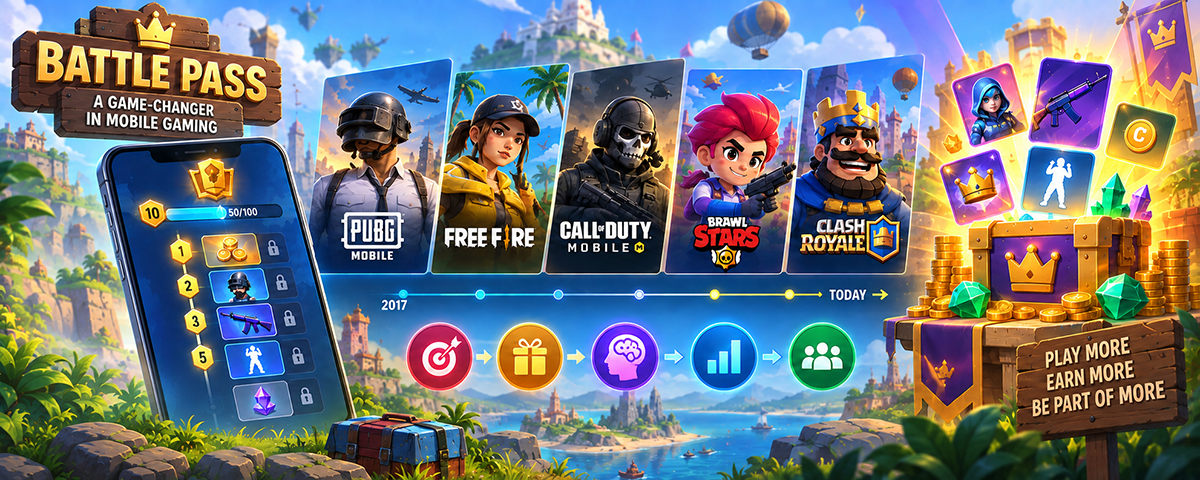
Every few weeks, hundreds of millions of people hand over roughly ten dollars for something that changes absolutely nothing about how their game plays. No stat boost. No unlockable power. Just a skin, an emote, a spray, a loading screen — cosmetic, and nothing more.
They're not doing it because they need it. They're doing it because the season ends soon, and they don't want to be the one left without it.
That's the battle pass. It's arguably the single most successful monetization invention gaming has produced in the last decade, and mobile is where it actually made its real money. Battle passes now sit inside close to 60% of the world's top-grossing mobile games and are responsible for roughly a fifth of all in-app purchase revenue industry-wide.
This piece goes deep on three things: where the battle pass actually came from (it wasn't built for mobile, and it wasn't even called a "battle pass" at first), the behavioral psychology quietly running underneath every season, and five mobile games that turned this mechanic into serious, measurable revenue and retention wins. No PC titles in the case studies. Just the numbers from the platform that actually matters here.
The battle pass didn't start on a phone. It started at a Dota 2 tournament.
In 2013, Valve released something called the Compendium for that year's The International, Dota 2's marquee esports event. For $10, players got a digital booklet that let them make predictions about the tournament — who'd win, which hero would get picked most, who'd land the fastest kill — and climbing through those predictions unlocked cosmetic rewards along the way. A quarter of every sale went straight into the tournament's prize pool.
It worked immediately. The prize pool started that event at $1.6 million and ended it at $2.87 million, funded almost entirely by fans buying into the Compendium. Valve had stumbled onto something bigger than a tournament gimmick: people would pay real money for a progress bar tied to rewards, as long as that progress bar was attached to something they already cared about.
Valve kept iterating. The 2014 Compendium introduced 1,000 levels of unlockable progress and helped push that year's prize pool past $10.9 million. By 2015, the prize pool had crossed $16 million. Somewhere in this stretch, Valve also tried a smaller, quieter version of the same idea in Team Fortress 2 — a "campaign pass" tied to a limited event — which never fully took off, but proved the underlying model wasn't a one-game fluke.
Then, in 2016, Valve folded the Compendium into a larger structure and gave it the name that stuck: the Battle Pass.
Dota 2's own version kept climbing for years after that — the 2021 Battle Pass alone generated over $38 million toward a record $40 million prize pool. Then the model cooled: a 2022 redesign broke community expectations, sales declined for the first time in half a decade, and by 2023 Valve had quietly reverted the name back to Compendium. It's a useful reminder even at the very source of the format: the mechanic isn't self-sustaining forever. It has to keep earning the player's trust every single season, or the spending dries up fast.
The term "Battle Pass" existed for over a year before most gamers had ever heard of it. That changed in December 2017, when Fortnite launched the second season of its brand-new battle royale mode. Fortnite didn't invent the mechanic. It packaged it. Within about a year, "the Fortnite model" was the reference point every studio pitched internally when they wanted to justify building one of their own.
By 2018, the format had jumped platforms entirely — and this is where the story splits from "PC gaming curiosity" into "mobile gaming's biggest revenue lever." The moment battle passes landed on phones, inside free-to-play economies already built around small, frequent payments, the mechanic found its actual home.
No Fortnite, no Dota 2, no PC or console numbers in what follows — just the five mobile games that took this mechanic and turned it into real, measurable money.
Strip away the branding, and every battle pass — mobile or otherwise — is built from the same handful of parts:
That last point matters more than it looks like it should. Because rewards are earned through play rather than random chance, a battle pass is technically not a loot box — you know exactly what you're getting and exactly what it costs to get there, with no randomized odds attached. That distinction has let the battle pass largely sidestep the regulatory scrutiny loot boxes have drawn in multiple countries.
The real genius of the structure is the price anchor. Ten dollars for 60 to 100-plus items feels like an obvious bargain next to buying any single one of those items from the shop directly — even though most players will never fully complete the pass, and the studio behind it knows that going in.
This is the part that actually explains why battle passes make so much money. It's not the rewards themselves. It's the six or seven behavioral mechanisms stacked underneath them, each one quietly doing its own job.
In a well-known behavioral study, researchers gave one group of customers a car-wash loyalty card requiring 8 stamps, and another group a card requiring 10 stamps — except the second card arrived with 2 stamps already filled in, meaning both groups actually needed the same 8 more visits to earn a free wash.
Battle passes lean on this constantly. Log in on day one of a new season and you're often already partway up the ladder — a welcome bonus, a head-start challenge, some free XP just for showing up. You haven't spent anything yet, and you already feel like you're "in progress." That feeling is doing a lot of the persuasive work before a single dollar changes hands.
Back in 1932, behaviorist Clark Hull noticed something simple while studying rats in a maze: they ran faster the closer they got to the food at the end. Decades of later research on humans — loyalty programs, gift certificates, reward ladders — found the same pattern. Effort and spending both accelerate the nearer a goal gets.
This is why the final stretch of a battle pass season reliably produces a spike in tier-skip purchases. A player casually grinding through tier 40 suddenly sees the finish line at tier 100, and the pull to close that gap — with money, if that's what it takes — gets noticeably stronger the closer the season gets to ending.
Battle pass rewards aren't just earned, they're time-boxed. Miss the season, and that skin is typically gone for good. Behavioral economics has a well-documented finding here: losing something hurts more than gaining the equivalent thing feels good. A battle pass works by quietly reframing "I didn't buy this skin" into "I'm about to lose this skin" — even though nothing was ever actually taken from anyone.
Once someone buys the premium track, the psychology flips from "should I buy this?" to "I already paid — I need to use it." Players frequently describe grinding through daily challenges out of obligation rather than enjoyment, specifically to avoid feeling like their money was wasted. This doubles as a retention mechanic almost by accident: a player who's paid for the pass now has a concrete, self-imposed reason to open the app again tomorrow, and the day after, for the rest of the season.
Underneath the deterministic tier ladder, most battle passes sprinkle in a layer of unpredictability — surprise bonus tiers, mystery reward chests inside the pass, streak bonuses that aren't quite the same size every time. This echoes the classic "variable schedule" reward mechanics long studied in behavioral psychology: rewards that arrive unpredictably tend to be more compelling, and harder to walk away from, than rewards that arrive on a fixed, entirely predictable schedule.
Russian psychologist Bluma Zeigarnik found that people remember unfinished tasks far more vividly than completed ones — an open loop sits in working memory and quietly nags at you until it's closed. A battle pass is, by design, always an open loop. There's always a next tier, a daily challenge still unclaimed, a currency counter one tap away from its next milestone. That unfinished quality is precisely what makes players think about the pass outside the app — a small, persistent mental tab that a push notification only needs to tap to bring someone back.
Cosmetics function as a walking billboard. A rare emote or skin earned through a battle pass signals commitment and status to squadmates and spectators, and that visibility does real behavioral work in any game with a social or competitive surface. This taps into three core drivers from Self-Determination Theory: autonomy (many newer passes let players choose which rewards to chase first), competence (the tier ladder is a literal, visible measure of effort and mastery), and relatedness (shared clan or guild passes, and the simple act of showing off a new skin to friends).
None of these mechanisms is especially powerful in isolation. Loyalty cards run on endowed progress alone. Fitness apps run on streaks and loss aversion alone. Slot machines run on variable rewards alone. What makes the battle pass unusually effective is that it runs all of them at once, on the same ten-dollar purchase, every few weeks, indefinitely.
"The battle pass earns its money by being genuinely good at making players feel urgency that has nothing to do with whether they're actually having fun."— The tension every studio building a pass has to sit with
Theory is nice. Here's what happens when this psychology gets built into an actual mobile game's economy — five titles, five different genres, all mobile-only, all with the numbers to show the battle pass isn't just a nice-to-have feature.
The pass that re-ranked the entire game commercially in one week
When Tencent and Krafton launched PUBG Mobile's Royale Pass in mid-2018, the game had been struggling to find a monetization rhythm, averaging around $170,000 a day in global player spending. According to Sensor Tower Store Intelligence data, the Royale Pass changed that within a week: global spending jumped 365% over the prior three-week average, pulling in roughly $6.1 million in its first seven days alone.
That wasn't a one-off spike. Sensor Tower's tracking showed PUBG Mobile settling into a sustained daily run-rate nearly 4× higher than its pre-pass baseline, and its position on the US App Store's top-grossing chart jumped from the 100–150 range into a consistent top 50 — all within the pass's very first season. By the time that season wrapped roughly six weeks later, the game had crossed $50 million in cumulative spending.
That early boost compounded into one of mobile gaming's biggest long-term success stories. PUBG Mobile has generated more than $9 billion in lifetime player spending, and over $15 billion once regional variants like China's Game for Peace and India's BGMI are counted in, per industry tracking through early 2026. Seven-plus years after that first Royale Pass, the game still pulls in somewhere between $90 million and $140 million a month.
The Royale Pass didn't just add a new revenue line. It re-ranked the entire game commercially, in one week, without touching the core gameplay at all.
Proof you don't need a bigger player base — you need deeper engagement
Free Fire was built from day one for markets where high-end phones and $60 games were never the norm — Brazil, India, Southeast Asia, Latin America — and its Elite Pass became the recurring monetization backbone that let a genuinely low-spend player base still generate serious revenue at scale. The game became the most-downloaded mobile title in the world in 2019, and by that November had already crossed $1 billion in lifetime spending.
The recovery story is the more interesting data point. In Q1 2026, Sea Limited (Garena's parent company) reported gaming revenue of $696.6 million, up 40.6% year-over-year — while the active player base barely moved, holding at roughly 666.5 million versus 661.8 million a year prior. Every bit of that growth came from existing players spending more: the paying-user rate climbed from 9.8% to 10.9%, and average spend per paying player rose from $1.17 to $1.40. Garena's own reporting pointed directly at the Elite Pass, live events, and brand partnerships as the drivers behind that shift.
Today, Free Fire holds around 130 million monthly active users and 33 million daily active users, and generated $408 million in 2024. Its ARPDAU sits at a modest $0.03 — a deliberate strategy to monetize a genuinely enormous, price-sensitive player base lightly and repeatedly, rather than a smaller base heavily.
Free Fire is proof you don't need a bigger player base to grow revenue. You need your existing players engaging more deeply with the pass — and Garena's most recent quarter is a clean demonstration of exactly that.
100 million downloads in a week, $1.8B and counting
Call of Duty: Mobile launched on October 1, 2019, and immediately set a mobile gaming record: over 100 million downloads in its first week, and 172 million within two months. The battle pass was built into the game from day one, as part of the wider Call of Duty franchise's pivot to seasonal content that same year.
The results since then have been remarkably consistent rather than explosive. Call of Duty: Mobile has generated more than $1.8 billion in lifetime in-app purchase revenue as of mid-2025. In 2024 alone it ranked as the 23rd highest-grossing mobile game worldwide, pulling in over $262 million in net IAP revenue, and it continues to post monthly revenue in the $22–30 million range.
Its season structure shows how far the format has been refined: a 50-tier core progression track extendable up to 200 tiers, dual free and premium reward lines, and multiple purchase options ranging from a standard pass to a bundle to a $10.99-a-month subscription — giving players several different price points to convert at, not just one.
Even in one of the most competitive shooter genres on mobile, where cosmetics carry zero mechanical benefit, a well-run battle pass can anchor hundreds of millions of dollars a year in reliable, repeatable revenue.
The best case study in this entire piece — Supercell rebuilt it twice
Brawl Stars might be the single best case study in this entire piece, because Supercell has been unusually open about exactly how much the Brawl Pass has mattered to the game's fortunes — including the stretch when it wasn't working.
The Brawl Pass launched in 2020, the same year Brawl Stars crossed $1 billion in lifetime revenue. But by early 2023, Supercell's own team publicly acknowledged the game had fallen to its weakest point ever. What happened next is the genuinely interesting part: between June 2023 and February 2024, Supercell rebuilt the Brawl Pass almost from the ground up — pulling newly-released Brawlers out of the pass and into direct store purchases, replacing them with more cosmetics inside the pass itself, shortening season length, and increasing the XP pass owners could earn.
The combined result, as Supercell later shared publicly: revenue up 8.8×, daily active users up 3.9×, and monthly active users up 2.4×, in under eight months. In 2026's Update 65, Supercell introduced a keys-based system letting players choose which category of reward to unlock next rather than forcing one fixed order. By March 2026, monthly active users hit 49.8 million.
Brawl Stars proves the battle pass isn't a "build it once" feature. For Supercell, rebuilding the pass itself turned out to be a bigger lever than any single marketing push or user-acquisition campaign — twice.
The format's staying power — best-ever year after nine years on the market
Supercell's Clash Royale introduced Pass Royale in 2019, and the immediate effect on the game's economy was dramatic: average in-game spending per player jumped more than 70% the year it launched. Pass Royale became the backbone of the game's monthly monetization from that point on, resetting every season in step with the game's content calendar.
Clash Royale's more recent chapter is arguably even more remarkable. After peaking at $708 million in revenue back in 2017, the game had settled into a long, slow decline — down to $202 million in 2024. Then came 2025: full-year revenue hit $646.8 million, roughly tripling year-over-year, driven by a complete overhaul of the game's progression systems (Pass Royale included) combined with a genuinely organic wave of streamer and community attention. New player growth was up 500% year-over-year, and Clash Royale posted its best download year since 2017 — nearly a decade after launch. Lifetime player spending across the game now sits close to $5 billion.
Pass Royale shows the format's staying power. Even a nearly decade-old mobile game can post its best year ever once the core progression loop — pass included — is genuinely right.
Battle passes work everywhere. But mobile is where the mechanic actually found its ideal habitat, for a handful of very specific reasons.
Session structure. Mobile play happens in short, frequent bursts — a few minutes on a commute, a match or two before bed — rather than the long, continuous sessions typical of PC or console. Daily and weekly missions built around bite-sized objectives are purpose-built for that rhythm; you don't need an hour free to make progress on your pass, you need three minutes, five times a day.
Price sensitivity in the biggest markets. Two of the five games above — PUBG Mobile and Free Fire — built their largest player bases in India, Brazil, and Southeast Asia, regions where a $60 upfront game purchase was never realistic but a $5–10 recurring habit genuinely is. The battle pass's low price anchor made premium-feeling mobile gaming financially accessible in exactly the markets where mobile-first gaming was already exploding.
A player base already trained on microtransactions. Long before the battle pass existed, mobile free-to-play games had already spent years training players to make small, frequent in-app purchases — energy refills, gacha pulls, currency packs. A ten-dollar seasonal pass didn't feel novel to mobile players the way it did to console gamers used to buying a game once and being done with spending. It felt familiar.
Direct access to the player's attention. Push notifications give mobile developers a channel PC and console studios don't have in the same way — a direct nudge that says "3 days left on your pass" straight to a device someone checks dozens of times a day. That's a FOMO delivery mechanism built straight into the operating system.
Social visibility where it matters most. Several of the biggest battle-pass markets — Brazil, India, Indonesia — also carry some of the largest mobile gaming creator and streaming cultures anywhere, which amplifies the status and social-proof effects of exclusive cosmetics well beyond what happens organically in smaller PC or console communities.
A live-ops cadence PC and console teams can't match. Mobile studios routinely ship weekly events, balance tweaks, and mini-updates alongside the pass itself — Brawl Stars' own turnaround leaned on more than 25 separate events and offers layered in over a single eight-month stretch. That constant drip of freshness keeps a single multi-week season from ever feeling stale.
Mobile wasn't just an additional platform for this mechanic — it's where the mechanic actually matured. Battle passes now show up in roughly 6 out of every 10 top-grossing mobile games and account for around a fifth of all mobile IAP revenue.
Revenue is the headline number, but it's a lagging indicator. Teams running battle passes well are watching a handful of quieter metrics that tell them whether the psychology is actually landing.
Brawl Stars' publicly shared 8.8× revenue and 3.9× DAU swing is really a story about several of these metrics moving together at once — completion rates, renewal rates, and retention lift all improving in the same eight-month window because the underlying pass mechanics got reworked, not because of a single marketing push. That's the pattern worth copying: treat the pass as a system to keep tuning, not a feature you ship once and leave alone.
It's worth being honest about the trade-off underneath all of this, because a deep dive that only counts the revenue isn't really a deep dive.
The fair defense: a battle pass is not a loot box. Rewards are earned through deterministic play, not random chance — players know exactly what they're working toward and exactly what it costs. That's a meaningfully different, and generally less predatory, design than gambling-adjacent randomized mechanics, and it's a big part of why battle passes have mostly avoided the regulatory attention loot boxes have drawn in several countries.
But researchers and child-safety advocates have pushed back on the idea that this makes the model harmless. The core critique is that battle passes simply relocate the manipulation from randomness to urgency — FOMO and sunk cost doing the work that random-number generators used to do elsewhere. Psychology researchers have specifically flagged the risk for younger players, who may have less capacity to self-regulate against a system explicitly engineered to make "one more session" feel necessary rather than optional.
There's also a built-in fairness question in the free-versus-premium split: free-track rewards are typically, deliberately, less exciting than premium ones, specifically so players feel what they're missing. That's not an accident of the system. It is the system.
The battle pass earns its revenue partly by being genuinely good at making players feel a low-grade urgency that has nothing to do with whether they're actually having fun. That tension — a genuinely effective business model built on genuinely real psychological pressure — isn't fully resolved even among the people who build these systems for a living.
The format is still evolving, and the direction of that evolution is telling.
Less linear, more flexible progression. Brawl Stars' 2026 keys-based Brawl Pass overhaul lets players pick which category of reward to chase next instead of forcing one fixed order. Other major live-service titles have experimented with similar non-linear structures. The direction is clear: give players more of a sense of control over the grind, without giving up the underlying progression hook.
Shorter, more frequent seasons. Mobile teams have increasingly learned that a 4-week season creates more re-conversion moments per year than an 8-to-12-week one — more season endings means more FOMO deadlines, which means more chances to sell a fresh pass.
Hybrid subscription models. Call of Duty: Mobile's monthly subscription bundle and Clash Royale's experiments with a smaller "Mini Pass" both blend battle-pass mechanics with the more predictable recurring revenue of a subscription — capturing mid-spenders who want in, but don't want to commit to a full premium pass every single season.
Smarter, more personalized offers. As mobile studios lean further into player-level data, expect reward tracks and pricing that adapt more to individual play patterns rather than one single pass design for an entire player base — though this is still an emerging direction rather than an established norm.
Whatever shape it takes next, it will still be built on the same handful of behavioral levers this whole piece has been about: a sense of progress, the fear of losing it, and the quiet math of a sunk cost. Those don't go out of style. They just get better wrapping paper.
"Whatever shape it takes next, it will still be built on the same handful of levers: progress, fear of losing it, and the quiet math of a sunk cost."— The battle pass, in every form it has ever taken
The battle pass started as a $10 prediction booklet at a Dota 2 tournament in 2013. Valve gave it a name in 2016. Fortnite gave it a global audience in December 2017. But it was mobile gaming — with its short sessions, price-sensitive markets, and a player base already comfortable with small, frequent purchases — that turned the mechanic into a genuine industry habit.
PUBG Mobile's Royale Pass nearly quadrupled daily revenue in a week. Free Fire's Elite Pass is still driving 40%-plus quarterly revenue growth without a single new player. Call of Duty: Mobile has run $1.8 billion through its pass since 2019. Brawl Stars rebuilt its way to an 8.8× revenue jump — twice. Pass Royale lifted Clash Royale's spending by 70% overnight and is still part of the engine behind the game's best-ever year, nine years after launch.
None of that happens by accident. It happens because a battle pass stacks six or seven well-understood psychological mechanisms — progress, urgency, sunk cost, variable reward, status — onto a single ten-dollar purchase, every few weeks, for as long as the game lives.
Whether you're building the next one or just trying to understand why you can't seem to quit yours: that's the real reason it works.